Institutional design proposal · July 2026
Aloha Intelligence Institute
Independently developed · prepared for consideration · not commissioned
Strengthen the institute before asking government to build it.
The policy question
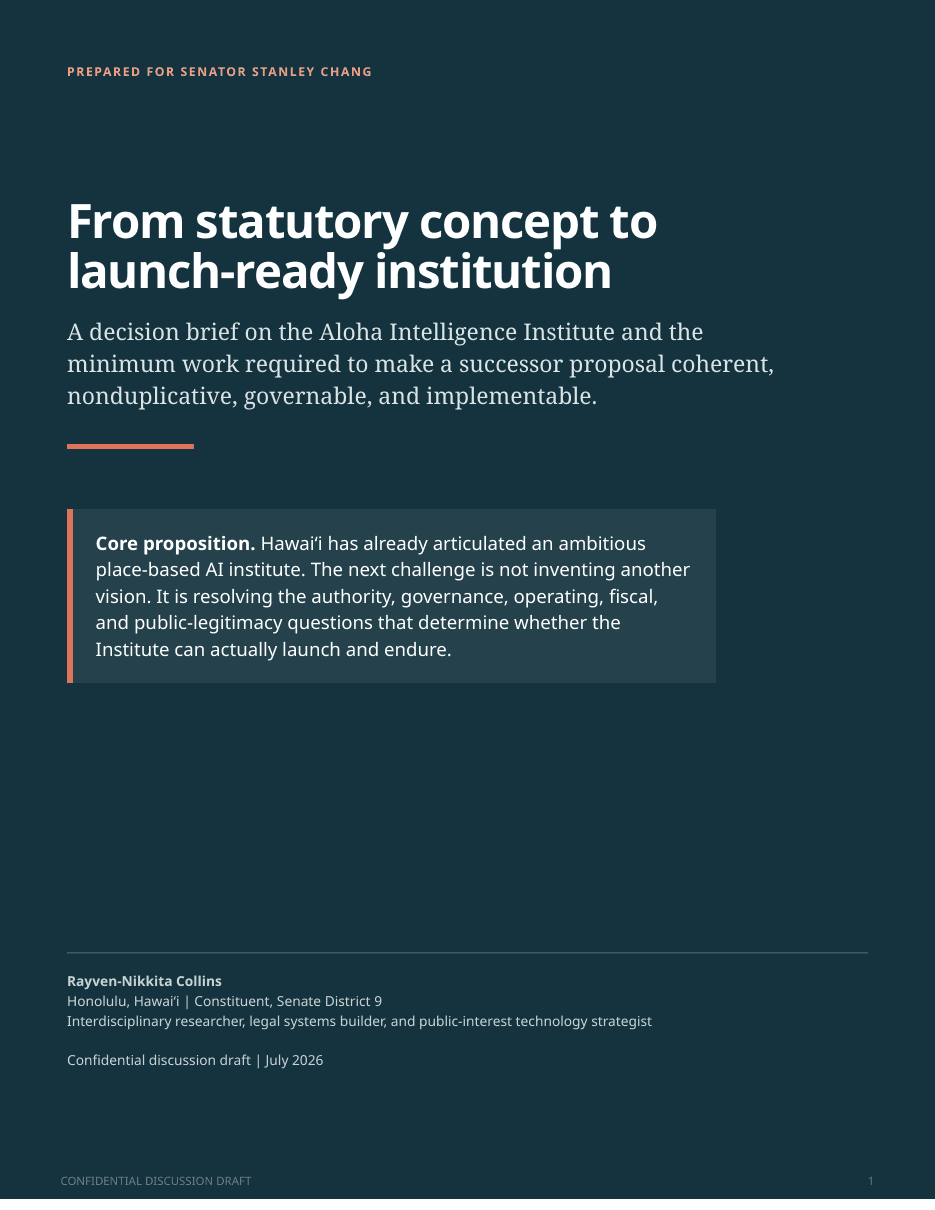
Hawaiʻi had already articulated an ambitious University of Hawaiʻi-based AI institute. The unresolved problem was whether its authority, governance, staffing, public legitimacy, funding, and first-year operating model were defined well enough to launch and endure.
The statutory audit
The brief compares SB 1622, SD1, HB 546, and their legislative movement; maps proposed functions against existing institutional responsibilities; and separates a substantial policy vision from the implementation choices still left open.
The decision architecture
It frames three credible paths—a planning-and-design office, a networked institute, and a fuller permanent institute—alongside the possibility that no new entity should be created. Each path is tested against authority, cost, duplication, reach, legitimacy, and capacity.
The proposed engagement
A bounded six-week legislative and institutional-design memorandum: primary-source audit, operating-model analysis, governance and legitimacy design, and a successor-legislation roadmap. The work explicitly excludes software procurement, a statewide AI code, or commitments made without an authorized sponsor.
What this demonstrates
Primary-source policy research, nonduplication analysis, institutional architecture, scope discipline, operating-option design, and the willingness to test whether a proposed institution should exist rather than presume that expansion is the answer.
What the brief actually is
A test of whether the institution should exist.
ProposalIndependently developed · July 2026 discussion draft · not commissioned or adopted
The method. The brief works from primary sources — the bills themselves and their legislative movement — rather than from coverage of them, and maps each proposed function against the institutional responsibilities that already exist. That mapping is the load-bearing part: a new entity justified by functions another body already holds is a duplication problem dressed as a capability problem, and it is only visible if someone does the comparison line by line.
Why the null option is on the table.Institutional-design work is usually commissioned by someone who has already decided the institution should exist, which makes “do not create it” unavailable as a finding. Holding it open changes what the other three paths have to prove. A planning-and-design office, a networked institute and a fuller permanent institute are each then tested against authority, cost, duplication, reach, legitimacy and capacity rather than against each other.
Scope discipline. The proposed engagement is a bounded six-week memorandum. It explicitly excludes software procurement, a statewide AI code, and any commitment made without an authorised sponsor — exclusions stated up front because the failure mode of this kind of work is a mandate that grows quietly until nobody can say what was agreed.
What it does not establish. This is a discussion draft prepared for consideration. It is not a legislative finding, an endorsement, an adopted plan, or a commitment by any office or institution named in it, and the analysis reflects the statutory record as it stood in July 2026.